
| HOME PAGE | |
| PHYSICAL OCEANOGRAPHY | |
| TOPICAL | |
| AERIAL PHOTOGRAPHY | |
| SOFTWARE | |
| PUBLICATIONS |
For current
e-mail address
postal address
telephone number
please refer to the Home Page
This page was updated on 16th September 2013.
COASTAL RESEARCH - Tidal Power - Devon leads the world
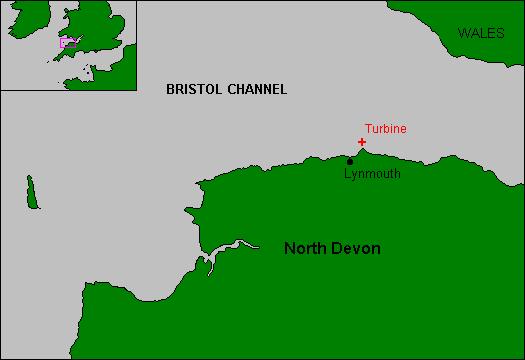
In 1998 COASTAL RESEARCH undertook site selection studies on behalf of IT Power for an open sea tidal turbine. The result was the channel between Foreland Ledge and Foreland Point on the North Devon coast near Lynmouth. This section of water has tidal streams in excess of 5 knots at Spring tides. Since 1998 IT Power has been involved in developing the turbine technologies to harness this power and convert it to electricity, building on its long experience of rugged intermediate technologies. In March 2000 the Exmoor National Park Authority gave approval for electric cabling to be led back to the coastline. Unfortunately, the government did not provide funding for the undersea cabling. Funding for the turbine came from the European Union.
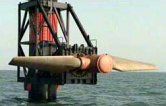
Spring 2003 The world's first open sea tidal turbine was put into operation just off Foreland Point at Latitude 51 degrees 15.3 minutes North, Longitude 3 degrees 47.5 minutes West. On Monday 16th June 2003 the installation was officially inaugurated. The final development phases and future trials were managed by a new company, Marine Current Turbines, who plan to exploit the technology in many other other parts of the world, particularly in island and remote communities.
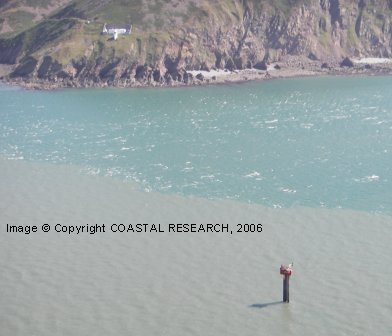
The choice of Foreland Point was enabled through COASTAL RESEARCH's long experience of inshore tidal streams and their characteristics. Many places around the coast of Britain and Ireland have strong tidal streams but few of them are suitable for the installation of large turbines. This is because of sea bed geology and associated wave-current interactions. Operational engineering considerations also include the sea bed route and distance of the heavy cabling required to bring the electricity ashore.
Other tidal power schemes have been developed including the famous Rance Estuary scheme in Northern France. These evolved from the medieval tidal mills found in many estuary locations. The Foreland Point scheme was the first to be sited in the open sea, on a steel pile, rigidly fixed to the sea bed.
March 2005 Following the success of the first turbine, Marine Current Turbines were awarded a DTI grant to proceed with a second turbine unit which was to have two rotors attached to a single steel pile. Final plans were awaited but there was the possibility that this new installation would also be located off Foreland Point near Lynmouth. The new installation would have had an undersea cable that would bring the electricity back to shore near Lynmouth - enough to power all Lynton and Lynmouth. Because the new installation would have had larger diameter rotors it would have been located in slightly deeper water, further seaward than the 2003 turbine.
Thursday 17th November 2005 Marine Current Turbines formally announced their commitment to the Foreland Point site and explained their plans to place an array of ten turbine piles, all linked to an undersea cable, within a few years. This would have produced more than enough electricity to keep Lynton and Lynmouth, and much of North Exmoor, fully supplied at all times of the year.
In 2006 Marine Current Turbines changed the focus of their efforts to a dual rotor project in the entrance channel to Strangford Lough, Northern Ireland. Different funding opportunities were a major factor in the decision. The Strangford Lough turbines feed their power into the grid.
In the Autumn of 2009 the turbine at Foreland Point was decommissioned and the upper portion of the pile was removed. Although a development project, it had generated power for six years. Such a pity that the project was not able to include an undersea cable to bring the power ashore and into the grid. If it had, the value of the electricity would have exceeded the capital cost of installing an undersea cable in 2003.
Severn Tidal Barrage Proposal(s)